
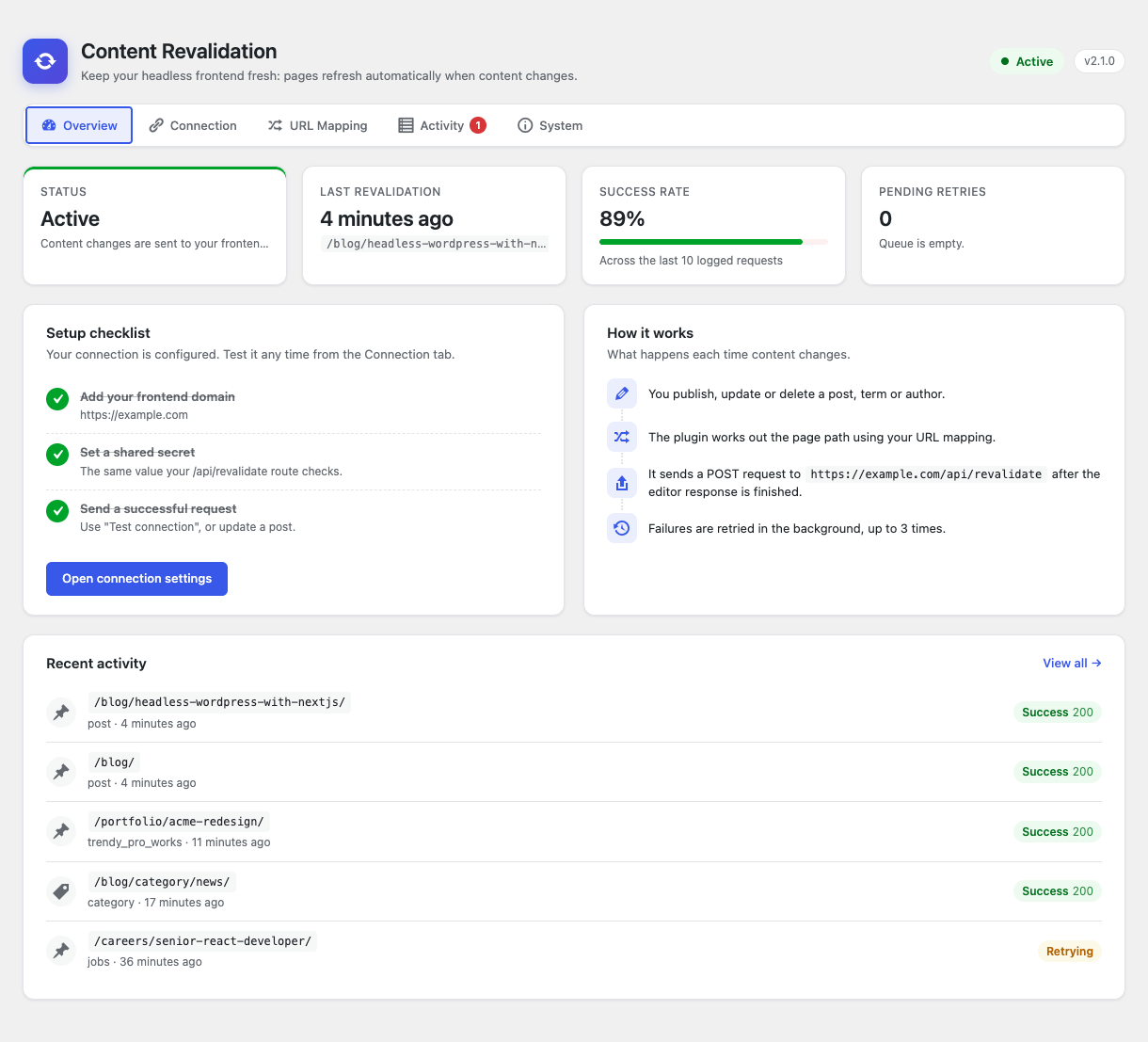
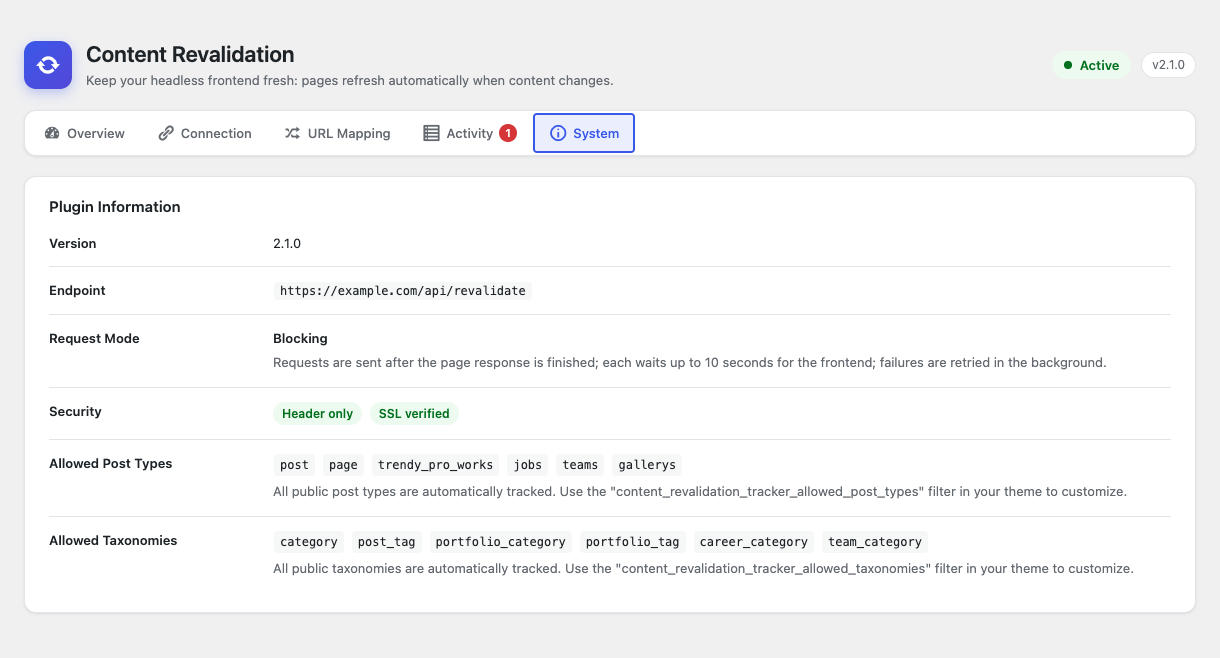

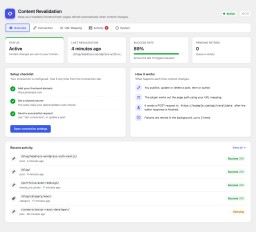


Content Revalidation Tracker connects headless WordPress to your frontend. When content changes, the plugin sends a secure request to your frontend’s revalidation endpoint, so the affected pages are rebuilt right away and visitors never see stale content.
It works with Next.js on-demand ISR, Nuxt, Astro, Gatsby or any framework that can expose an API route.
How it works
You publish, update, unpublish, trash or delete a post, page, term or author.
The plugin works out the frontend path using your URL mapping (for example
/blog/my-post/).It sends
POST https://your-frontend.com/api/revalidate?path=/blog/my-post/with the secret in theX-Revalidate-Secretheader.Your frontend revalidates the page. If the request fails, the plugin retries it in the background.
Features
Automatic revalidation for posts, pages, custom post types, categories, tags, custom taxonomies and author archives.
Slug changes handled: both the old and the new URL are revalidated.
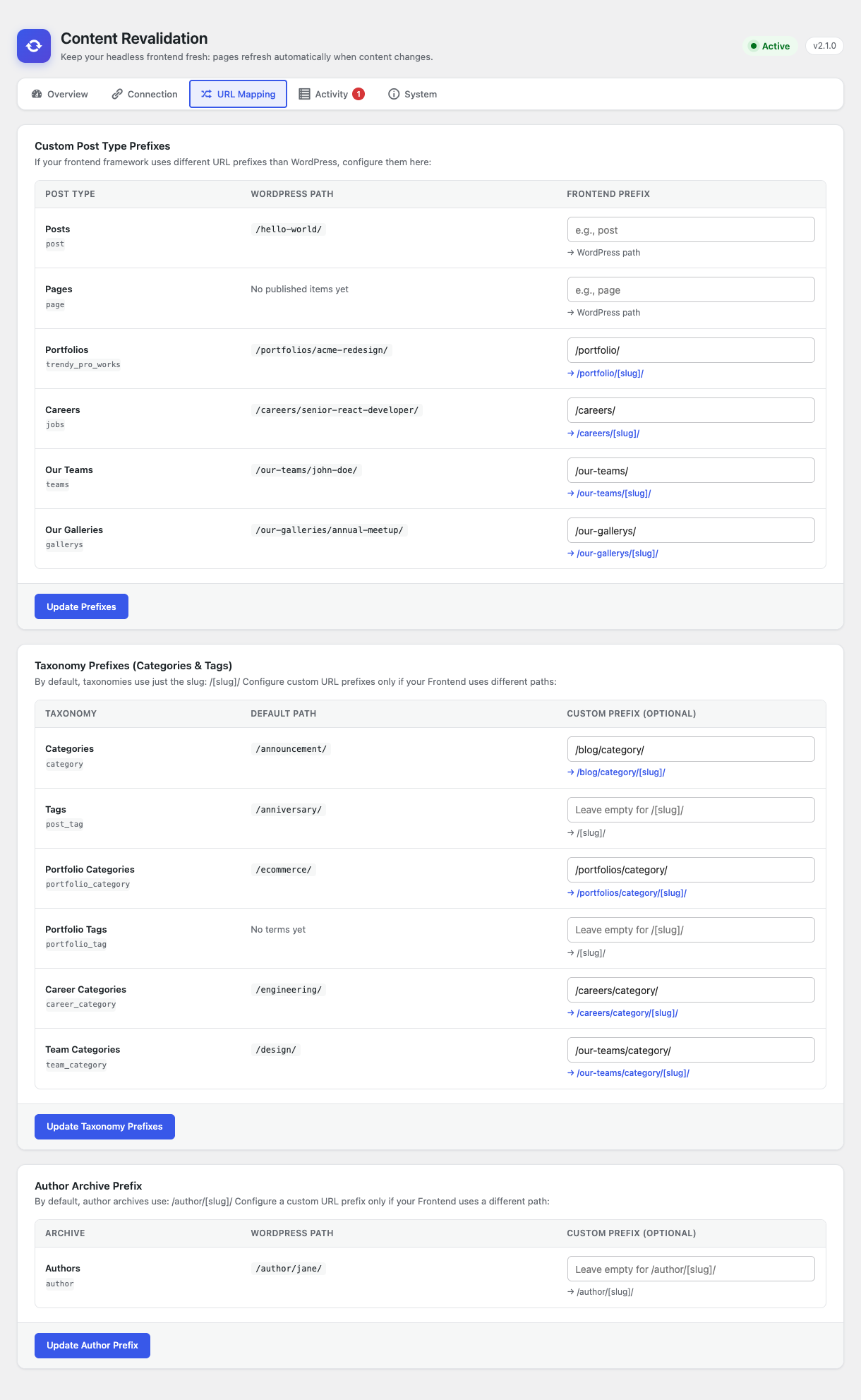
URL mapping: match your frontend routes with per post type, per taxonomy and author archive prefixes, with a live preview of the resulting path.
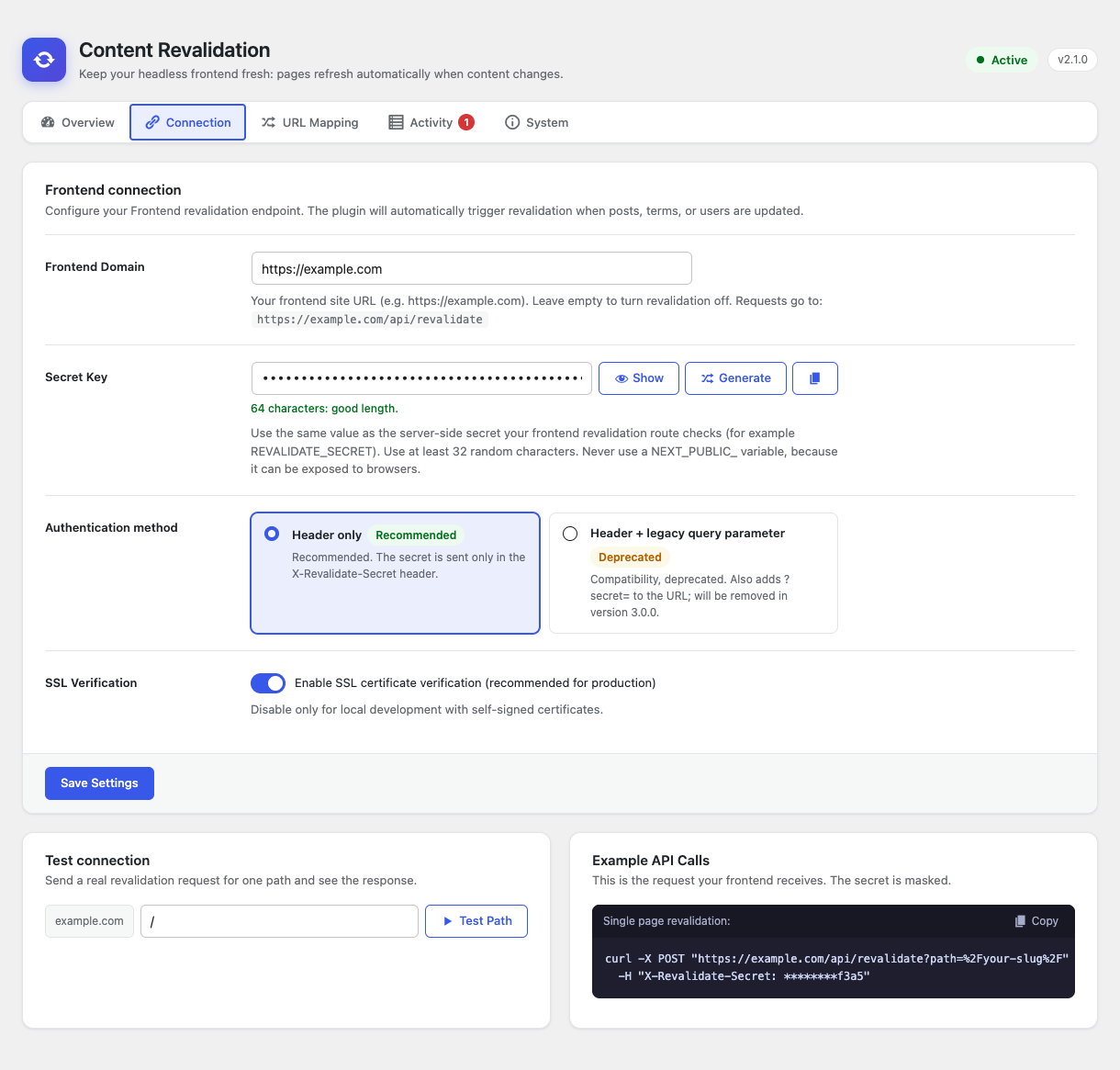
Secure by default: the secret is sent in a request header, never stored in the activity log, and masked on the settings page. A secret generator is built in.
Fast for editors: requests are sent after the editor’s response is finished, so saving a post is never slowed down.
Reliable: timeouts, rate limits and server errors are retried in the background through WP-Cron.
Built for bulk changes: bulk edits, imports and WP-CLI loops are sent in parallel (10 at a time) with a retry queue of up to 5,000 paths.
Test tool: send a real revalidation request for any path and see the response.
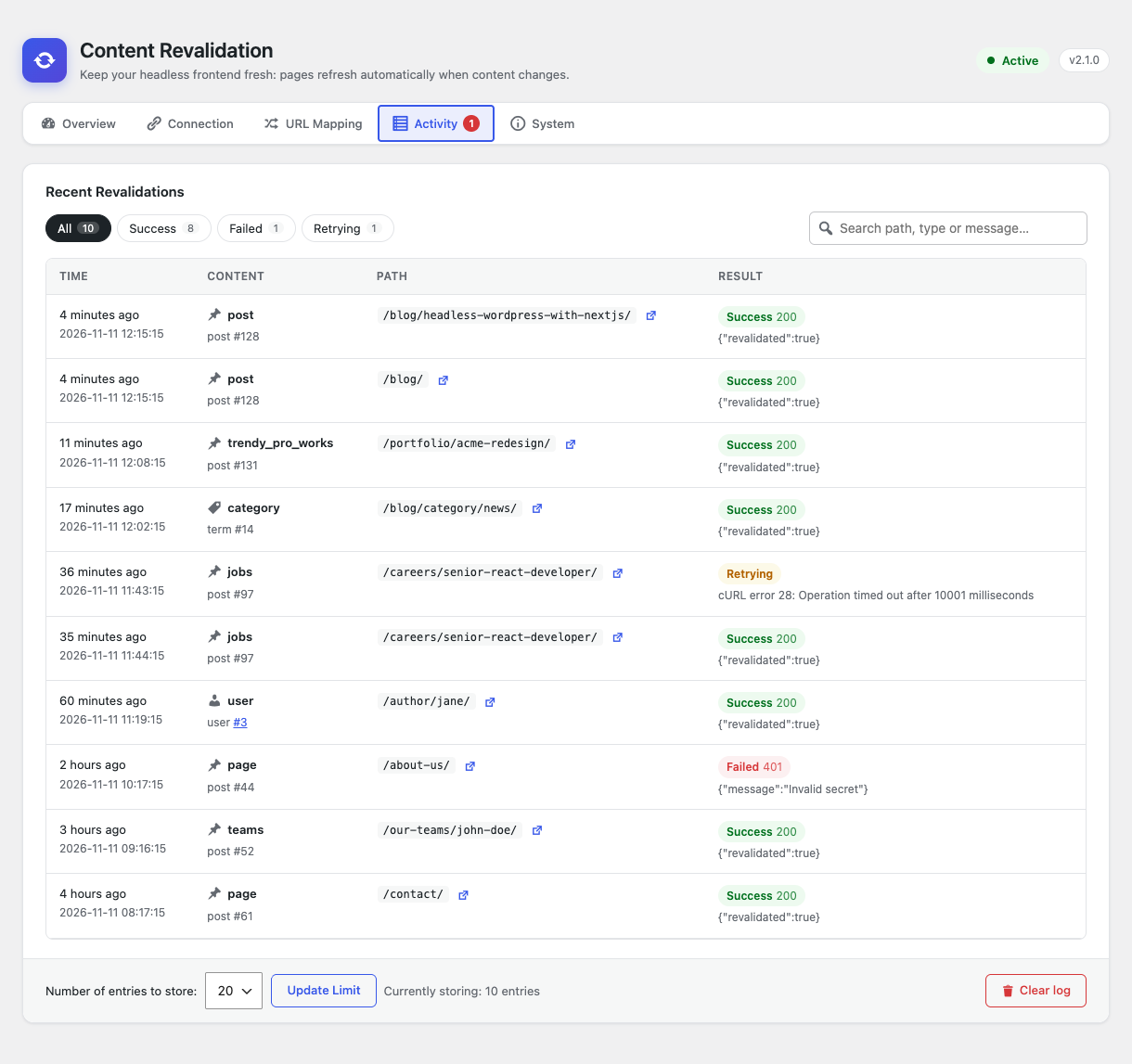
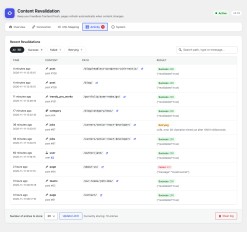
Activity log: see the HTTP status of recent requests, filter by success, failure or retry, and search by path.
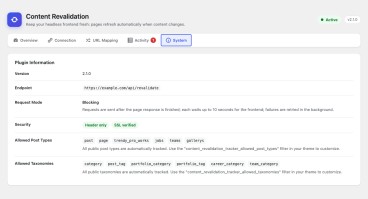
Developer friendly: filters for allowed post types, taxonomies, prefixes, timeouts and concurrency.
Clean uninstall: deleting the plugin removes all of its data, including on multisite.
Who it is for
Headless WordPress sites with a Next.js, Nuxt, Astro or Gatsby frontend.
Sites that use static generation or incremental static regeneration and need fresh pages without full rebuilds.
Agencies that want a simple, reliable link between editors and the frontend.
Frontend endpoint example (Next.js App Router)
Create app/api/revalidate/route.ts on your frontend. Keep the secret in a server-only environment variable such as REVALIDATE_SECRET, never in a NEXT_PUBLIC_ variable.
import { revalidatePath } from 'next/cache';
import { timingSafeEqual } from 'node:crypto';

const SECRET = process.env.REVALIDATE_SECRET ?? '';
const ALLOW_LEGACY = process.env.ALLOW_LEGACY_QUERY_SECRET === 'true';

function matches(value: string | null): boolean {
  if (!value || !SECRET) return false;
  const a = Buffer.from(value), b = Buffer.from(SECRET);
  return a.length === b.length && timingSafeEqual(a, b);
}

export async function POST(req: Request) {
  const url = new URL(req.url);
  const ok = matches(req.headers.get('x-revalidate-secret'))
    || (ALLOW_LEGACY && matches(url.searchParams.get('secret')));
  if (!ok) return Response.json({ message: 'Invalid secret' }, { status: 401 });
  const path = url.searchParams.get('path');
  if (!path) return Response.json({ message: 'Missing path' }, { status: 400 });
  revalidatePath(path);
  return Response.json({ revalidated: true, path });
}


ALLOW_LEGACY_QUERY_SECRET is only needed while migrating from the old `?secret=` query parameter. New sites can leave it unset.
Developer filters
content_revalidation_tracker_allowed_post_types: limit which post types are revalidated.content_revalidation_tracker_allowed_taxonomies: limit which taxonomies are revalidated.content_revalidation_tracker_author_prefix: change the author archive prefix.content_revalidation_tracker_request_timeout: request timeout in seconds (default 10).content_revalidation_tracker_concurrency: parallel requests per run (default 10).content_revalidation_tracker_batch_time_limit: time budget per run in seconds (default 30).content_revalidation_tracker_retry_queue_limit: maximum paths in the retry queue (default 5,000).